Tuesday, November 3, 2009

How to spot an AIDS denialist


Rogues, pseudoscientists, snake oil peddlers – Seth Kalichman reveals the sinister tactics used by those who deny the link between HIV and AIDS in a new article in The New Humanist magazine.

Imagine that you or someone you love just received an HIV positive test result. The news is devastating. After a short time you begin to face the diagnosis. You turn to the Internet for answers. Searching the words “AIDS diagnosis” brings up thousands of websites. A whirlwind of information spins your mind.

One credible-looking website, Aids.org, reads: “There is no cure for AIDS. There are drugs that can slow down the HIV virus and slow down the damage to your immune system. There is no way to ‘clear’ HIV from the body. Other drugs can prevent or treat opportunistic infections (OIs). In most cases, these drugs work very well. The newer, stronger ARVs have also helped reduce the rates of most OIs. A few OIs, however, are still very difficult to treat.”

With a click of the mouse, an equally credible-looking site, Aliveandwell.org, asks: “Did you know … Many experts contend that AIDS is not a fatal, incurable condition caused by HIV? That most of the AIDS information we receive is based on unsubstantiated assumptions, unfounded estimates and improbable predictions? That the symptoms associated with AIDS are treatable using non-toxic, immune-enhancing therapies that have restored the health of people diagnosed with AIDS and that have enabled those truly at risk to remain well?”

Which do you trust? Which do you believe? Which would you want to believe? Would you choose to believe there may be hope offered by medical treatments or would you prefer to believe that HIV is harmless? This simple example illustrates the lure of AIDS denialism.

Read the whole story at The
New Humanist.

Read more!

Wednesday, October 28, 2009

"Hello Professor, a Brent Leung is here to see you"


House of Numbers continues to be the talk of AIDS Denialism. There are many lessons to be learned from the AIDS Denialist crockumentary House of Numbers. The real lesson for scientists is that just because a guy has a camera crew does not mean you should agree to be interviewed by him. Thinking twice before sitting down in front of a camera is a worthwhile lesson indeed. The October 15 issue of Nature, a magazine well known for its excellent book reviews, published a great story on the hazards of scientists appearing in documentaries gone wrong. Too bad the article came out after House of Numbers was in the can. I post the article here for future reference.


And don’t forget to check out the new House of Numbers Website. Everyone should see House of Numbers.But be sure to read up before going.


UPDATE: Editors at Science Daily react to the misrepresentation (lying?) about T-Cells and AIDS twisted in House of Numbskulls.

UPDATE: Joseph Sonnabend, MD - Physician and AIDS Researcher speaks out on the fraud behind House of Numbers.


Caught on camera

What to do when you are interviewed for an unscientific documentary


Stephen Schneider, a climatologist at Stanford University in Palo Alto, California, has always had to deal with angry e-mails from people who think that global warming isn't happening, and that Schneider is part of a conspiracy to promote it. He has been vocal about the dangers of climate change for decades.

In the past week, however, Schneider has been deluged by furious messages. They have been provoked by a clip circulating on the Internet from Not Evil Just Wrong, a documentary film claiming that global-warming fears are 'hysteria'. The clip explains how Schneider did an interview — and then how the university informed the film-makers that it had rescinded permission for using any of the Stanford footage and that Schneider had withdrawn permission to use his name or interview. Schneider says he backed out when he realized that the film-makers were polemicists who had lied to him about their intentions. Some climate-sceptic commentators are accusing him of censorship.

Schneider is by no means the first scientist to feel hoodwinked by film-makers. British evolutionary biologist Richard Dawkins ended up in Expelled: No Intelligence Allowed, a film purporting to show how academics who do not accept evolution are frozen out of academia. Dawkins says that he was conned — that the film-makers had presented the project to him as an even-handed effort entitled Crossroads: The Intersection of Science and Religion. Carl Wunsch, an oceanographer at the Massachusetts Institute of Technology in Cambridge, felt he was "swindled" in a like manner by the producers of The Great Global Warming Swindle. And Nikos Logothetis of the Max Planck Institute for Biological Cybernetics in Tübingen, Germany, let a seemingly objective film crew into his primate laboratory — only to see the footage used in an animal-rights documentary that slams him as cruel.

For many scientists, the natural response to such stories is to stop talking to the media. But that would be an overreaction. For one thing, such misrepresentations are rare. Schneider estimates that he has given some 3,500 interviews since the 1970s, and only twice has he been "set up". Most journalists and documentarians are honestly trying to report the facts, and scientists have a responsibility to tell the public about their work — especially if it is supported by public money.

Fortunately, scientists can do much to protect themselves. When someone asks for an interview, for example, a scientist should enquire about starting assumptions, the intended audience and the identity of the project's backers. And, if possible, researchers should check the earlier work of the journalists and any companies behind the film for a partisan tone, or unacceptable levels of sensationalism.

But if these efforts fail, and it is discovered too late that the film-makers are bent on using an on-tape interview to promote a view that seems unscientific, the question becomes what steps to take. There is rarely a way to withdraw an interview that was given on the record, for good reason. In any case, making a fuss can be a gift of publicity to film-makers. Schneider admits that he might have spared himself the deluge of e-mails had he just ignored the makers of Not Evil Just Wrong.

A better approach might well be to complain to the television channels and broadcasting regulators, many of which have standards for their programming. The Great Global Warming Swindle was censured by Ofcom, Britain's broadcasting regulator, for breaking several rules in its broadcasting code. And when the same documentary was aired by the Australian Broadcasting Corporation, it was followed by a point-by-point debate and rebuttal.

In the end, this is perhaps the most effective way to limit the damage. Bad journalism is best met not with red-faced indignation, but with good journalism. The truth is the best revenge.


Read more!

Tuesday, October 20, 2009

Harvard Symposium on Denialism, Mistrust & Stigma


Death by denial:Symposium explores HIV denial, conspiracy theories

By Alvin Powell Harvard Gazette

People who deny that the HIV virus causes AIDS continue to persist in their beliefs despite overwhelming scientific evidence to the contrary, nurtured by the broad reach of the Internet and cherry-picked scientific claims, AIDS authorities said Monday.

Researchers from Harvard, elsewhere in the United States, and South Africa convened at the Carpenter Center for the Visual Arts to decry HIV “denialism,” saying that the continued questioning of HIV’s role in AIDS harms those infected with the virus by discouraging both testing and treatment.

According to the speakers, denialism takes two major forms. Some skeptics deny that HIV plays a role in AIDS, or that it even exists, while others believe in AIDS conspiracies, acknowledging that HIV causes AIDS but questioning HIV’s origins, saying it results from a government conspiracy, is intended as a genocide campaign against blacks, that it was created in CIA labs, or is of other sinister origin or purpose.

The event, sponsored by the Harvard University Center for AIDS Research, was presented in conjunction with the Carpenter Center’s exhibit “ACT UP New York: Activism, Art, and the AIDS Crisis, 1987-1993.” The exhibit contains posters, T-shirts, fliers, and pamphlets from ACT UP’s AIDS activism campaigns which, through sometimes graphic and jarring messages, pushed government action against AIDS. The campaign argued that the government dragged its feet because of homophobia and racism aimed at two groups prone to the ailment: gay men and intravenous drug users, who are often minorities.
Laura Bogart, associate professor of pediatrics at Harvard Medical School and Children’s Hospital Boston, introduced the event, saying that denialism also includes odd beliefs, such as that drugs for HIV treatment actually cause AIDS. Denialism, she said, is gaining momentum because of the reach that its proponents have on the Internet, and it may have greater traction in communities that already mistrust the government because of past discrimination, revelations of secret medical experiments, and the like.

The symposium examined how denialism affects prevention and treatment, public policy, and human rights.

“Bad ideas have bad consequences,” Bogart said.

Kalichman, professor of psychology at the University of Connecticut, said denialist beliefs are surprisingly widespread. He said most people’s attitude when hearing of HIV denial is, “Oh, those people are still around?” In the uncertain early years of the AIDS epidemic, Kalichman said, denialists were dissidents from the prevailing but still uncertain scientific views. As the body of evidence about the nature of HIV and AIDS grew, dissent turned into denial, wrapped in conspiracy theories. Now, Kalichman lumps HIV denialists with those who deny the Holocaust and global warming, and who believe 9/11 conspiracy theories. All use similar strategies, he said, including false experts, bad science, and selective use of valid scientific results.

Kalichman cited a 2007 report on 696 gay men in five U.S. cities that showed a surprisingly high acceptance of denialist beliefs. Forty-five percent, he said, agreed with the statement “HIV does not cause AIDS,” and 51 percent agreed with the statement “HIV drugs can harm you more than help you,” remarking that it would be troubling if even half those numbers believed such statements.

Kalichman said research shows that the Internet is a critical source of denialist information, and that people who hold denialist beliefs are more likely to have symptoms, less likely to adhere to drug regimens, and less likely to take treatment medication in the first place.

Denialism may have done its most damage in South Africa during the tenure of President Thabo Mbeki. Mbeki, who endorsed denialist beliefs, delayed the beginning of large-scale AIDS drug treatment, which allowed the pandemic to grow unchecked.
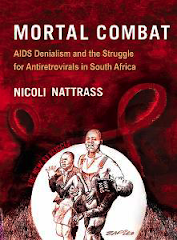
Nicoli Nattrass, director of the AIDS and Society Research Unit and economics professor at the University of Cape Town in South Africa, presented preliminary results from a large-scale study of teenagers and young adults there. The results, which are still being analyzed, show that denialist beliefs are held disproportionately by black African men and are far more likely to be held by those supportive of Mbeki’s health minister, who has been replaced by the current administration.

Recent research showed how damaging denialist beliefs can be, concluding that Mbeki’s failure to roll out HIV drugs between 2000 and 2005 resulted in 330,000 unnecessary deaths and the infection of 3,500 infants with HIV

Read more!

Friday, October 9, 2009

Can Peter Duesberg be Trusted on Cancer?

This week's News Week Magazine raises questions regarding Peter Duesberg's credibility as a cancer researcher. Duesberg is best known for his AIDS Denialism. What many may not know is that Peter Duesberg maintains a small laboratory privately funded by Robert Leppo where he researches potential causes of cancer.

Peter Duesberg was among the first scientists to isolate cancer-causing genes and cancer-related retroviruses. Early in his career, Duesberg worked with other Berkeley scientists, including acclaimed molecular biologist G. Steve Martin, to discover the first cancer-causing genes—oncogenes. The Berkeley Group was among the first to demonstrate that retroviruses carry oncogenes that transform normal cells into deadly cancer cells.

Understanding the genetics of cancer brought about new and sophisticated technologies that have become critical in cancer prevention and treatment. Peter Duesberg’s work in cancer also led to his election to the National Academy of Sciences in 1986. The citation for his membership to the Academy reads:

The first true oncogene, src, was identified and mapped by Duesberg. He also chemically mapped the entire viral genome and then duplicated these feats for three major mouse sarcoma viruses and some half-dozen avian sarcoma and leukemia viruses.

Having done important work on the genetics of cancer, Peter Duesberg made what appears to be a radical shift in his thinking in the early 1980s. To put it simply, he changed his mind about the cause of cancer. During this time, he published papers in the distinguished journals Nature and Science in which he completely dismissed the role of retroviruses and oncogenes in causing cancer.

He refuted his own contributions and criticized other cancer researchers who had embraced oncogenes as a cause of cancer, including prominent and influential researchers such as J. Michael Bishop and Harold Varmus, whose work on oncogenes— just across the bay, at the University of California San Francisco—led to a Nobel Prize in 1989.

Duesberg shifted his view of cancer toward a theory proposed by the German scientist Theodor Boveri (1862–1915), who in 1914 proposed that chromosomal mutations, not gene mutations, collectively called Aneuploidy are the cause of cancer. Aneuploidy is the name given to cells that develop an abnormal number of chromosomes.

Aneuploidy can result from exposure to environmental toxins including radiation, chemicals, and other carcinogens. Duesberg takes the extreme position that Aneuploidy is not the effect of cancer, but rather the opposite; that Aneuploidy resulting from life style is the sole cause of all cancers.

Duesberg simply extended his new view that viruses do not cause cancer to also explain AIDS.
The question is, can we trust Peter Duesberg’s cancer research? Duesberg blatantly ignores science to propagate his belief that HIV does not cause AIDS. He cherry picks research results for the sake of argument. Duesberg uses every trick in the denialst playbook to distort reality regarding HIV causing AIDS. Can Peter Duesberg be at once an AIDS denialist and a trusted cancer scientist? Should we forget about the harm he has caused to people affected by AIDS, including his role in promoting AIDS denialism in South Africa?

New Insights from an Old Student

In contemplating Peter Duesberg’s credibility on cancer, insight can be gained from a former student’s reflections on his time with Duesberg. Respected neuroscientist Samuel Pfaff recently shared his experiences as Duesberg’s student at Berkeley in the article “Making the Most of Opportunities and Challenges” by science writer Robin Mejia.

When neuroscientist Samuel Pfaff was a postdoc at Vanderbilt University in Nashville, he and his future wife often visited her family in Pasadena, California. On one of those visits, the couple decided to take a side trip to San Diego. As they drove down Torrey Pines Road, he saw the Salk Institute for Biological Studies perched on a bluff overlooking the Pacific Ocean.

"I still have a really vivid memory," Pfaff says. "I remember thinking, "Anyone who runs a lab there has to be one of the luckiest people in the world. They must have the perfect career.' "
Today, many would say almost the exact same thing about Pfaff. The scientist doesn't just have a lab at the Salk Institute: He sits in Jonas Salk's former office--or part of it at least; the office has been subdivided--next to Salk's favorite window, which features a removable glass pane that Pfaff takes out some days to let in the sea breeze.

Pfaff's life may look charmed from the outside, but his path to the Salk Institute presented a mix of opportunities and challenges, occurring, often as not, when they were least expected. The first time he saw the building that has since become his scientific home, he was recovering from a difficult graduate experience at the University of California (UC), Berkeley: It was the late 1980s, and his graduate adviser, the renowned virologist Peter Duesberg, had become an outspoken skeptic of the then-new proposition that HIV causes AIDS. Pfaff recalls that he and Duesberg were barely on speaking terms by the time Pfaff finished his Ph.D. Pfaff was uncertain whether he would be able to find the kind of independent research position he sought.

Early promise, early challenges

Raised in Rochester, Minnesota, Pfaff discovered his affinity for science early. When he was in high school, a teacher suggested he talk to a neuroscientist at the Mayo Clinic, which led to Pfaff's first position in a biology lab. "I started as a volunteer. I'd go straight from school," he says. "For somebody my age, it was just an incredible opportunity to be involved in making discoveries."

From Rochester, Pfaff went to Carleton College in Northfield, 40 miles from home. Although research options were limited at Carleton, he confirmed his love of science there and discovered developmental biology. He was thrilled when, in 1983, UC Berkeley accepted him as a graduate student. And after a series of rotations, he settled into Duesberg's lab, where he hoped to learn microbiology.

"He was truly a hotshot at that particular stage of his career," Pfaff recalls. "He was well-funded, maybe one of the best-funded labs [at Berkeley]. His students were publishing lots of papers, going to great postdocs." When he first arrived there, Pfaff found Duesberg inspirational, devoted to science, and always at the bench. Pfaff was working in Duesberg's lab when he was elected to the National Academy of Sciences in 1986.

Then, Pfaff says, things started to change. Duesberg became more and more critical of other scientists and, particularly, of research being done on HIV and AIDS. In 1987, Duesberg published a paper arguing that HIV is harmless. He maintains that position today; it's one that's made him a scientific pariah.

Being Duesberg's student at the time the senior scientist was staking that position was a challenge. "He was losing the respect of other scientists. I wondered what that would mean for me," Pfaff recalls. "[At scientific meetings], I remember the feeling of embarrassment telling people this is the lab I work in and fearing they wouldn't come to my poster, thinking I'd talk about HIV and AIDS, when my research had nothing to do with it."

He says lab meetings became difficult to stomach and that, being both young and stubborn, he probably didn't handle his disagreements with Duesberg very gracefully. "There was, I'm sure, a lot of body language on my part that he didn't appreciate. ... I just sort of stopped talking to him. Even though we might be standing right next to each other [at the bench], we'd be trying not to acknowledge each other. Looking back, I'm not proud of my behavior," he says. "I just wanted to do enough research to finish my dissertation and get out of there."

"I think he was the least happy of my graduate students," Duesberg says. Duesberg does not recall that the two stopped speaking but concurs that it was not a successful match.

Finding his way

Given that he was trying not to speak to his adviser, Pfaff moved forward on his own. Eventually, he managed to finish his Ph.D. research and publish two papers on different oncogenes, but he was not particularly proud of the work. (He says his committee members commented that the dissertation seemed average, and he didn't disagree.) The experience left him drained. He wasn't ready to give up on a career in science, but he felt certain he wasn't qualified to apply for postdocs at major research institutions.

"I didn't feel I would even be considered by some of the better laboratories in the country. Maybe I had low self-esteem. I wasn't getting any career advice," he says. At that point, he and his girlfriend (now his wife) had been maintaining a long-distance relationship for 3 years while she pursued a Ph.D. at Vanderbilt University. Unsure what to do next, Pfaff decided to see if he could find a position in a lab at the school. William Taylor, a scientist there, was starting to do molecular biology in frog embryos, a system that had fascinated Pfaff as an undergrad.

Taylor recalls that he asked about Pfaff's graduate experience, but he was more interested in the young scientist's abilities than his mentor's views. "I asked and he implied that those were Peter's ideas, not his," says Taylor, now director of the Molecular Resource Center at the University of Tennessee Health Science Center in Memphis. He offered Pfaff a postdoc position. "Sam was by far the brightest person in the lab," Taylor says. "It was like having another PI [principal investigator] in the lab; it was amazing."

For Pfaff, the time in Taylor's lab was a chance to work with a mentor who took an interest in his research and his career. "It gave me a chance to reestablish myself in science," he explains. By the time his wife finished her Ph.D., Pfaff's project was wrapping up, but he still felt unable to compete for the kind of position he dreamed of. "I thought I could probably be considered for positions where my primary position would be teaching and I could maybe dabble in science," he recalls.

At about that time, a mutual friend introduced Pfaff to Thomas Jessell, a neuroscientist at Columbia University. Jessell says he felt Pfaff had picked up useful virology skills in Duesberg's lab regardless of Duesberg's position on AIDS. Pfaff's work in Taylor's lab showed that the young scientist "could work on problems in a rigorous way," says Jessell, now Claire Tow Professor of neuroscience, biochemistry and molecular biophysics and co-director of Columbia's Kavli Institute for Brain Science. "I think I just got the idea that Sam was very competent." It didn't hurt that Pfaff brought microbiology skills that Jessell needed at the time. He offered Pfaff a postdoc.

"When I went to Jessell's lab, I knew it was just an incredible opportunity, and I also knew it was my last chance if I was going to stay in research science," Pfaff recalls. Pfaff again switched systems, helping Jessell's lab start doing mouse genetics. His work on how the selective expression of LIM homeobox genes regulates the development of neurons in the embryonic spinal cord helped set the stage for future research in Jessell's lab and, later, Pfaff's own. "It was our first real foray into gene targeting," Jessell says. "I think it made it clear that [the problem] was approachable."

Independence

As that project came to an end, Pfaff finally felt ready to apply for the kind of research positions he'd been thinking about since high school. He received offers from "about a half-dozen institutions," he says.

The Salk Institute didn't offer the biggest financial package, but it did offer the La Jolla bluffs. Even more important, it offered a collegial environment and colleagues Pfaff could envision as future collaborators. He accepted the offer, and in 2005 he cleared the last hurdle, becoming full professor there. In 2008, he was named a Howard Hughes Medical Institute Investigator. He continues to study the fetal development of the spinal cord.

Pfaff says he hasn't spoken with Duesberg since he left Berkeley, and Duesberg says he hasn't had any new graduate students in his lab since he began arguing against the link between HIV and AIDS. Pfaff says his experience in the lab at Berkeley has shaped how he runs his own lab today: He considers mentoring a key component of his job.

"I tell students, 'There will be some point in your career where things will not be optimal.
You'll have to deal with some aspect of disappointment,' " he says, noting that it's easy to do good work when everything's going well. "You're defined by what you do when you encounter challenges."

Read more!

Thursday, October 1, 2009

Moron AIDS Denialist Film House of Numbers: Notes from the show

Having seen the AIDS Denialist film House of Numbers, I must say that it is worse than anyone could imagine. The film misuses the words of leading AIDS scientists to raise doubts about whether HIV causes AIDS, the validity of HIV testing, and the benefits of HIV treatments. Context is everything, and House of Numbers creates an illusion of debate among scientists by placing scientists along side of pseudoscientists. All Doctors and Professors are equal in the eyes of Director Brent Leung.

Contorting words to misrepresent reality is what AIDS Deniers do. Some AIDS Deniers must distort reality to protect their bubble of denial. HIV infected persons who are living in an AIDS denial delusion appear in the film, such as the late Christine Maggiore. Also not surprising are the words of the professional AIDS Deniers, who simply repeat the denialist mantra heard so many times before. The mosaic is fascinating to those of us who study AIDS Denialism, reaffirming to those living in denial, and boring to tears for everyone else.

In case you are smart enough to have not seen the film, I offer you some of my favorite AIDS Denialist quotes. I wrote down much of what was said in the film because, well, I am a really good note taker. Here you have it… AIDS Denialism’s greatest hits delivered in House of Numbers.
UPDATE: UK Raindance Film Festival shows House of Numbers. UK Skeptics respond. Ben Goldacre's Bad Science Gimpy's Blog
Eleni Papadopulos-Eleopulos: We do not say that HIV doesn’t exist. What we say is that the presently available data does not prove the existence of HIV.
It’s one thing to look like and another thing to be a virus.


Peter Duesberg: For them to justify their expenses and their existence, and make their careers they have to find infectious diseases. The more diseases they can lump into this AIDs syndrome the better the chances they get patients under the umbrella.

If Fauci would say that here’s a billion dollars for alternate theories of AIDS, you wouldn’t believe what is going to happen. A lot of HIV researchers overnight would find would start [studying] co-factors. The first year they would call it co-factors of HIV.

They are all prostitutes, most of them, my collogues, to some degree, including myself. You have to be prostitutes to get money for your research. You are trained a little bit to be a prostitute. But some go all the way.

Nineteen million Americans now, 19 million, are taking illicit toxic medications. But we do not talk about this, this is politically incorrect.

That is AIDS by prescription. You get an immune deficiency and you die from the toxins.


Celia Farber: The changes and the definition have been political. Every time they change the definition, the numbers go up. This word AIDS, I don’t know what it is anymore. I don’t know what we talk about anymore when we talk about AIDS. AIDS is one thing in Greenwich village and very different thing in Kampala, Uganda.

Kary B. Mullis: The CDC was looking for something like that, when it came along. They were looking for it already; they were hoping that there was going to be a new plague, because polio was over, the CDC’s budget was getting decreases back in the early 80s…There were memos around the CDC saying “we need to find a new plague”. We need to find something that will scare the American people so that they will give us more money! Suddenly there was a lot of money available for anybody who wanted to study HIV. And nobody ever looked back and said, “Why do we want to study HIV…Bob Gallo said on TV causes AIDS?” We don’t know what AIDS is; AIDS is so hard to define, we could change the definition of it every year.

It was like a mad wonderful kind of dance that was being done, but if you think that can happen forever, you are wrong. What exactly caused Kaposi Sarcoma, we know that now. It was amyl nitrite.

Neville Hodgkinson: Whole nations have been lead to believe that in some instances that they’ve got large percentages of their population infected and doomed because of this supposed sexually transmitted virus. It’s such a tragedy. Because of the different criteria that apply in different countries you can test HIV positive in one country and be given an AIDs diagnosis as a result of that where as in another country you won’t test HIV positive and you won’t be given an AIDs diagnosis. It does not allow you to tell a single person on this planet that they are HIV positive. And it’s a scandal that this test continues to be used.

Christian Fiala: In the era before AIDS we had to admit we don’t know the diagnose and we could hypothesis, but nowadays what doctors do is well, if we don’t know what it is then it must be AIDS. : I think it is important to keep in mind, especially for us in the west, that poverty is not a romantic issue. It is a deadly issue. Poverty leads to disease and premature death, period! I think HIV totally has turned out not to be the cause of AIDS. HIV has turned out not to be.

Claus Koehnlein: The treatment causes a very similar condition we would expect from an AIDS patient. That’s why nobody noticed there was something wrong with the patient. That is the very reason why everybody believes that HIV is a deadly virus because the HIV positive patients at the time got a deadly treatment.

Nobody wants to realize what was the real effect of this over treatment. That means we killed a whole generation of AIDS patients. The AIDS medication today is not that toxic then it was in the early days. It’s a potent drug regimen which means it kills everything.

So patients really do better for the short term, but for the long term they die also.

I have patients tested in 1985. They were all advised to take treatment but they declined treatment for different reasons because they didn’t want to take toxic drugs, because they were feeling well at that time. They are still living healthy.

Read more!

Thursday, September 24, 2009

AIDS Denialist Crank Convention: Gearing Up for Oakland

"They are all prostitutes, most of them, my collogues, to some degree, including myself. You have to be prostitutes to get money for your research. You are trained a little bit to be a prostitute. But some go all the way." Peter Duesberg

I don’t know about you, but I am getting pretty excited about the Rethinking AIDS conference. What a great opportunity to meet all of the AIDS Denialists and learn about their latest delusions! I am familiar with the venue – same place Peter Duesberg held his Aneuploidy Conference. Truth is the Aneuploidy meeting attempted to present some science. There were some real scientists there, albeit not very comfortably. The Rethinking AIDS Conference promises to be even better. Just look at what the AIDS Deniers are saying…

Who Should Attend? — Anyone who has questions about the connection between HIV and AIDS should attend. If you are already convinced that the HIV=AIDS dogma is broken come and expand your understanding. If you aren't sure about it come and perhaps you will be by the end of the conference. If you are convinced that HIV is the cause of AIDS and want to understand why some people disagree, you are still welcome to come, listen, and participate in discussions.

Why Should you Come? — To learn about the history of the AIDS dogma, scientific flaws in the dogma, treatment of immune deficiency, legal issues and the human impact on HIV-positives.

What Can You Expect — You will see from the program that there will be many talks, with opportunities to ask questions and have group and individual discussions. Social events will allow networking with other people concerned about the science of HIV, the social and legal consequences of an HIV diagnosis and the censorship of science and the media.

PLUS…there will be a special showing of House of Numbers. Now wont that be special?
UPDATE: See Rethinking AIDS Program Below!
Mimicking scientific conferences is not unique to AIDS Denialism. In fact, conferences are an important part of creating a façade of legitimacy for pseudoscience. David Gorski has a great post at Science-Based Medicine on crank conferences. Here is an excerpt.
Crank “scientific” conferences: A parody of science-based medicine that can deceive even reputable scientists and institutions

If there’s one thing that purveyors of pseudoscientific medical modalities crave, probably above all else, it’s legitimacy. They want to be taken seriously as Real Scientists. Of course, my usual reaction to this desire is to point out that anyone can be take seriously as a real scientist if he is able to do science and that science actually shows that there is something to his claims. In other words, do his hypotheses make testable predictions, and does testing these predictions fail to falsify his hypotheses? That’s what it takes, but advocates of so-called “complementary and alternative medicine” (CAM) or “integrative medicine” (IM, or, as I like to refer to it: “integrating” quackery with scientific medicine) want their woo to be considered science without actually doing the hard work of science.

There are several strategies that pseudoscientists use to give their beliefs the appearance of science, a patina of “science-y” camouflage, if you will. One, of course, is the cooptation and corruption of the language of science, which has been a frequent topic on this blog, particularly in posts written by Drs. Atwood and Sampson. Another is to produce journals that appear to be science, but are anything but. I’ve discussed one example, the Journal of American Physicians and Surgeons and Medical Acupuncture, but others include Homeopathy, the Journal of Alternative and Complementary Medicine, and Medical Hypotheses, which recently was forced to retract a horrible paper by arch-HIV/AIDS denialist Peter Duesberg. What’s worse is that some of these journals are even published by what are considered major publishers, such as Mary Ann Liebert, Inc., and Elsevier.

There is, however, a third strategy. How do scientists communicate their findings to other scientists, as well as meeting and mingling with other scientists? Why, they hold scientific meetings, of course! These meetings can be small or even as large as the American Association for Cancer Research meeting, which is attended by around 15,000 cancer researchers each year. So, too, do cranks hold meetings. These meetings often have all the trappings of scientific meetings, with plenary sessions, smaller parallel sessions, poster sesssions, and an exhibition hall, complete with exhibits by sponsoring companies. Sometimes these meetings can even appear so much like the real thing that they take in legitimate researchers and legitimate universities. Here, I present two examples of such conferences. [to read the rest of Gorski’s post visit Science-Based Medicine]


Watch the Rethinking AIDS 2009 conference video.

RETHINKING AIDS CONFERENCE PROGRAM

Friday

3:00 Check-in6:00 Welcome and introduction of Keynote Speaker (
David Crowe) 6:15

Keynote Lecture (
Michael Tracey)

7:15 WELCOME COCKTAIL

Saturday
Morning Session

8:00 Opening remarks (
David Crowe)
8:10 History of the AIDS controversy spanning three decades (
John Lauritsen)
8:50 HIV-AIDS hypothesis out of touch with South African AIDS—a new perspective (
Peter Duesberg)
9:30 Questioning the Existence of HIV (
Etienne De Harven)

10:10 Coffee Break
10:30 The Deception and Dishonesty of African AIDS Statistics (
Charlie Geshekter)
11:10 Aids in Africa—a call for sense not hysteria (
Christian Fiala)
11:50 The role of the inner pharmacy in the prevention and treatment of AIDS (
Roberto Giraldo)

12:30 Lunch

Afternoon Session

2:00 HIV drugs causing AIDS (
Dave Rasnick)
2:40 The treatment dilemma of HIV-positive patients as a result of the HIV-AIDS hypothesis: The illusion of antiviral treatment (
Claus Koehnlein)
3:20 HIV/AIDS blunder is far from unique in the annals of science and medicine (
Henry Bauer)
4:00 Coffee Break
4:30 Screening of
House of Numbers
Evening
7:00 BANQUET

Sunday
Morning Session
8:00 The Criminalization of Illness (
Chris Black)

8:30 Rethinking Legal Aspects of AIDS in Colombia (Universidad Libre Pereira Colombia Law Group)
9:00 Censorship in the AIDS debate—the success of stifling, muzzling and a strategy of silence (Joan Shenton)
9:30 Coffee Break
9:45 Religion, Politics, and AIDS in Italy: curious paradoxes from the Ministry of Health (
Marco Ruggiero)
10:15 The Italian epidemiology supports the chemical AIDS theory (
Daniele Mandrioli)
10:45 How I fell victim to the AIDS machine (
Karri Stokely)
11:00 AIDS, Big Deal, Next!: A journey to hell and back with AIDS (
Noreen Martin)

11:15 Challenges faced by gays who question HIV/AIDS with implications for dissidents (Tony Lance)
11:30 Panel discussion
12:00 Close

Read more!

Friday, September 11, 2009

Duesberg's Medical Hypotheses Article Makes the Case for Peer Review

Having just posted my simulated peer review of Peter Duesberg’s shameful and retracted article where he once again proclaims that HIV is harmless, I could not resist sharing this. The UK’s premiere debunker of medical fraud and Bad Science, Ben Goldacre, writes about Duesberg’s retracted article in his weekly Guardian column. Once again, Goldacre delivers a very insightful piece. By the way, if you have not read Ben’s book Bad Science get it now… The chapter on AIDS Denialism and Matthias Rath is a real gem. If you are ever in London and have a chance to hear Ben Goldacre lecture, don’t miss him. The guy is a genius.

UPDATE: New article on retracted paper at AIDS Beacon

Peer review is flawed but the best we've got
Ben Goldacre The Guardian, Saturday 12 September

This week the peer review system has been in the newspapers, after a survey of scientists suggested it had some problems. That is barely news. Peer review – where articles submitted to an academic journal are reviewed by other scientists from the same field for an opinion on their quality – has always been recognised as problematic. It is time-consuming, it could be open to corruption, and it cannot prevent fraud, plagiarism, or duplicate publication, although in a more obvious case it might. The problem with peer review is, it's hard to find anything better.

Here is one example of a failing alternative. This month, after a concerted campaign by academics aggregating around websites such as Aidstruth.org, academic publishers Elsevier have withdrawn two papers from a journal called Medical Hypotheses. This journal is a rarity: it does not have peer review, and instead, submissions are approved for publication by its one editor.

Articles from Medical Hypotheses have appeared in this column quite a lot. They carried one almost surreally crass paper in which two Italian doctors argued "mongoloid" really was an appropriate term for people with Down's syndrome after all, because they share many characteristics with oriental populations (including: sitting cross-legged; eating small amounts of lots of types of food with MSG in it; and an enjoyment of handicrafts). You might also remember two pieces discussing the benefits and side-effects of masturbation as a treatment for nasal congestion.

The papers withdrawn this month step into a new domain of foolishness. Both were from the community who characterise themselves as "Aids dissidents", and one was co-authored by their figureheads, Peter Duesberg and David Rasnick.

To say a peer reviewer might have spotted the flaws in their paper – which had already been rejected by the Journal of Aids – is an understatement. My favourite part is the whole page they devote to arguing that there cannot be lots of people dying of Aids in South Africa because the population of the country has grown in the past few years.

We might expect anyone to spot such poor reasoning but they also misrepresent landmark papers from the literature on Aids research. Rasnick and Duesberg discuss antiretroviral drugs that have side-effects but which have stopped Aids being a death sentence, and attack the notion their benefits outweigh the toxicity: "contrary to these claims", they say, "hundreds of American and British researchers jointly published a collaborative analysis in The Lancet in 2006, concluding treatment of Aids patients with anti-viral drugs has 'not translated into a decrease in mortality'."

That is a simple, flat, unambiguous misrepresentation of the Lancet paper to which they refer.

What does this tell us about peer review? The editor of Medical Hypotheses, Bruce Charlton, has repeatedly argued – very reasonably – that the academic world benefits from having journals with different editorial models, that peer review can censor provocative ideas, and that scientists should be free to pontificate in their internal professional literature.

But there are blogs where Aids dissidents, or anyone, can pontificate wildly and to their colleagues: from journals we expect a little more.

Read more!